
England at the 2026 World Cup: History, Glory & How to Get There

There is a particular kind of madness that grips England every couple of years. It arrives with the first tournament fixture, spreads through pubs and living rooms and office WhatsApp groups, and convinces an entire nation — against six decades of accumulated evidence — that this could be the year. In the summer of 2026, that madness has a new and thrilling shape: a World Cup spread across an entire continent, played in the heat of an American June and July, in cities most England fans have only ever seen in films.
The 2026 FIFA World Cup kicked off on 11 June, and for the first time it is being co-hosted by three countries — the United States, Canada and Mexico — across sixteen host cities and 104 matches. It is the biggest World Cup in history: 48 teams instead of the old 32, a sprawling, coast-to-coast festival of football that turns following your country into a genuine road trip.
And England, the nation that gave the world the game, are once again chasing the one trophy that has eluded them for sixty years.
This is the JetMeAway Scout's complete guide to England and the World Cup — where the game began, the one golden afternoon in 1966, the decades of glorious heartbreak that followed, and everything you need to know about the 2026 tournament. And because we're a travel company at heart, we'll also show you exactly how to turn the dream of following the Three Lions across North America into a real, bookable, affordable trip.
England's 2026 World Cup Run — Quarter-Final vs Norway
Updated 8 July 2026. England have reached the quarter-finals of the 2026 World Cup. Next up: England vs Norway, on Saturday 11 July 2026, kick-off 10pm BST, at Hard Rock Stadium in Miami, Florida. Win it and the Three Lions are into the semi-finals — one step from a first World Cup final since 1966.
Chasing the dream and heading to Florida for the quarter-final? Sort the trip the JetMeAway way — no markups, no booking fees. Compare the best hotels in Miami for every budget, grab flights to Miami (MIA), and browse all Miami stays. Book early — quarter-final weekend is the busiest travel window of the tournament so far, and rooms near the stadium and the beach go fast.
Jump to a section: England's 2026 Run — Live · The Origins of Football · England's World Cup History · Iconic Moments · Has England Ever Won the World Cup? · The Royal Family & Football · History of the World Cup · 2026 Tournament Essentials · England's Group L Fixtures & Host Cities · Where to Stay · The 2026 England Squad · Tickets & Fixtures · Booking the Whole Trip · Budget Tips · Sample Trip · The Travelling Support · Why Book With JetMeAway · FAQ
England's World Cup record at a glance — the highs, the lows, and the one that counts:
| Year | Host | England's result | Remembered for |
|---|---|---|---|
| 1950 | Brazil | Group stage | Shock 1-0 loss to the USA |
| 1966 | England | 🏆 WINNERS | Hurst hat-trick, Moore lifts the trophy |
| 1970 | Mexico | Quarter-final | Heat, altitude, and Gordon Banks' save |
| 1990 | Italy | Semi-final (4th) | Gazza's tears, penalty heartbreak |
| 1998 | France | Round of 16 | Beckham's red card, Owen's wonder goal |
| 2002 | Korea/Japan | Quarter-final | The "Golden Generation" falls to Brazil |
| 2018 | Russia | Semi-final (4th) | Waistcoats, penalties won, "It's coming home" |
| 2022 | Qatar | Quarter-final | A narrow exit to France |
The Origins of Football: How England Gave the World the Beautiful Game
To understand why England obsesses over the World Cup the way it does, you have to understand that this is the country where football, as the planet now knows it, was born.

Ball games are ancient. People have been kicking, carrying and chasing inflated bladders and bundled rags for thousands of years, from China's cuju to the riotous "mob football" of medieval English villages — chaotic, semi-violent contests where entire parishes would try to manhandle a ball from one end of the settlement to the other, with few rules and frequent injuries. For centuries, "football" in England meant something closer to a brawl with a ball than the precise, flowing game we love today.
What England did was not invent the idea of kicking a ball. What England did was write the rules everyone now agrees on — and that act of standardisation is what created the modern sport.
In the early 19th century, England's public schools each played their own wildly different versions of football. Some allowed handling the ball and hacking opponents' shins; others didn't. When old boys from these schools went to university or into clubs, they could barely play a match together because nobody agreed on what was allowed. The solution came on 26 October 1863, when representatives of a dozen clubs and schools met at the Freemasons' Tavern in London and founded The Football Association — the FA, the oldest football governing body in the world. Out of those meetings came the first unified "Laws of the Game," which deliberately split football (no handling, no hacking) away from the handling code that would become rugby.
That rulebook is the direct ancestor of the laws used in every World Cup match in 2026. When a referee in Los Angeles or Mexico City blows the whistle this summer, they are enforcing principles first written down in a London tavern.

England also staged the first ever official international football match: on 30 November 1872, England played Scotland in Glasgow in front of around 4,000 spectators. It finished 0-0 — a scoreline that England fans would come to know intimately over the following century and a half — but it began the tradition of nations testing themselves against one another that the World Cup would eventually crown.

From those English roots, the game spread with extraordinary speed. British sailors, engineers, traders and teachers carried footballs and the FA's rules to every corner of the globe — to South America, where Brazil and Argentina would turn the game into art; to continental Europe; to Africa and Asia. Clubs founded by British workers still carry the evidence in their names. The world took England's invention and, in many cases, learned to play it better than the inventors. That tension — we made this game, why can't we win it? — is the emotional engine of English football to this day.
By the time FIFA was founded in Paris in 1904 and the first World Cup was staged in Uruguay in 1930, football had become the world's sport. England, somewhat sniffily, didn't even enter those early tournaments, partly due to disputes with FIFA and a lingering belief that the home nations were simply better than everyone else. It was a costly arrogance — and the reckoning, when it came, would be brutal.
England and the World Cup: A Complete History
England's relationship with the World Cup is one of the great love stories in sport — passionate, tortured, and overwhelmingly defined by near-misses punctuated by a single, blinding moment of glory.

The humbling start (1950)
England finally entered the World Cup in 1950, in Brazil, fancying themselves as one of the favourites. Instead, they suffered one of the most famous upsets in the tournament's history: a 1-0 defeat to the United States, a team of part-timers, in the city of Belo Horizonte. The legend goes that when the result was cabled back across the Atlantic, some British newspapers simply couldn't believe it — assuming the transmission of "USA 1, England 0" must have been a garbled typo, they "corrected" it in print to a thumping 10-1 win for England, certain the mighty inventors of the game could only have romped to victory. They hadn't. The nation that gave the world football had been beaten by a country that barely played it — the first hard lesson that inventing the game guaranteed nothing.
1966: England's greatest day
And then came the afternoon that every England fan, whether they were alive for it or not, knows by heart.
The 1966 World Cup was held in England, and manager Alf Ramsey had made a bold, almost arrogant promise: England would win it. His side — built around captain Bobby Moore, the elegant defender; the tireless Bobby Charlton in midfield; and a young West Ham striker named Geoff Hurst — ground their way to the final at the old Wembley Stadium, where 96,000 people packed in to watch them face West Germany on 30 July 1966.
What followed was pure drama. England led, were pegged back to 2-2 in the final minute of normal time, and went into extra time with the trophy slipping away. Then Geoff Hurst struck twice. His second of the day — England's third — remains the most debated goal in World Cup history: a fierce shot that cannoned down off the underside of the crossbar and was ruled to have crossed the line, a decision that to this day West German fans dispute. His final goal, hammered home in the dying seconds as fans spilled onto the pitch, sealed a 4-2 victory and made Hurst the first man ever to score a hat-trick in a men's World Cup final — a feat matched only once since, by France's Kylian Mbappé in 2022. Crucially, Hurst remains the only player to score a final hat-trick and finish on the winning side; Mbappé's came in a defeat.
As Hurst broke clear to lash in that fourth goal, the BBC commentator Kenneth Wolstenholme delivered the most famous line in English sporting broadcasting — "They think it's all over… it is now!" — the ball hitting the net just moments before the final whistle. Bobby Moore, wiping the Wembley mud from his hands so as not to dirty the Queen's white gloves, climbed the steps and lifted the Jules Rimet trophy. England were champions of the world.
It is, to this day, the only major senior men's trophy England have ever won. Sixty years later, it remains the sun around which all English footballing hope orbits.

The long ache (1970–2022)
What makes English football so compelling — and so painful — is everything that came after 1966.
- 1970 (Mexico): A genuinely brilliant England side, arguably stronger than the 1966 team, travelled to defend the trophy. Gordon Banks produced a save against Pelé's header that is still called the greatest of all time. But in the quarter-final, in the heat and altitude of León, England led West Germany 2-0 and somehow lost 3-2. The heartbreak template was set.
- 1986 (Mexico): The quarter-final against Argentina gave the world Diego Maradona's "Hand of God" — a goal punched in with his fist that the referee allowed — followed minutes later by the greatest solo goal ever scored. England lost 2-1, and a national grievance was born.
- 1990 (Italy): Perhaps the most beloved England campaign of all. Bobby Robson's team reached the semi-finals, where they faced West Germany again. After a 1-1 draw, it went to penalties; England lost, and a young Paul Gascoigne, booked in a way that would have ruled him out of a final England never reached, wept on the pitch. "Gazza's tears" turned a generation of casual observers into devoted fans and arguably saved English football's image after a grim decade.
- 1998 (France): An 18-year-old Michael Owen scored a goal of breathtaking maturity against Argentina, but David Beckham was sent off for a petulant flick at an opponent, England lost on penalties, and Beckham became, briefly, the most hated man in England — before redeeming himself in the years that followed.
- 2002–2006: The era of the "Golden Generation" — Beckham, Steven Gerrard, Frank Lampard, Wayne Rooney, Rio Ferdinand, John Terry. On paper, one of the most talented squads England ever assembled. In reality, repeated quarter-final exits (to Brazil in 2002, to Portugal on penalties in 2006) and a sense of vast potential unfulfilled.
- 2010 (South Africa): A dispiriting 4-1 thrashing by Germany in the last 16, made more bitter by a Frank Lampard "goal" that clearly crossed the line but went ungiven — a refereeing error so blatant it helped force FIFA to finally adopt goal-line technology.
- 2014 (Brazil): Out in the group stage, one of England's worst World Cups.
- 2018 (Russia): Redemption, of a kind. Gareth Southgate's young, likeable, waistcoat-wearing side actually won a penalty shootout (against Colombia), reached the semi-finals, and reunited the country in a wave of "It's Coming Home" optimism. They lost to Croatia in extra time, but the relationship between team and nation was healed.
- 2022 (Qatar): A strong campaign ended in a tight quarter-final defeat to France, with Harry Kane — England's all-time record goalscorer — missing a late penalty that would have forced extra time.
And it is not only the World Cup. England reached the final of Euro 2020 (played in 2021), losing to Italy on penalties at Wembley, and the final of Euro 2024, losing to Spain. Two major finals in three years — agonisingly close, yet still no trophy since 1966.

England's full World Cup record
| Tournament | Stage reached |
|---|---|
| 1950, 1958, 2014 | Group stage |
| 1954, 1962, 1970, 1986, 2002, 2006, 2022 | Quarter-final |
| 1982 | Second round (group) |
| 1998, 2010 | Round of 16 |
| 1990, 2018 | Semi-final (4th place) |
| 1966 | Champions 🏆 |
| 1974, 1978, 1994 | Did not qualify |
That single bold line in the table is the whole story. One star on the shirt. One summer. And a country that has spent sixty years trying to add a second.
Iconic England World Cup Moments
Some moments transcend the result. They become part of the national memory, retold every four years, recognisable from a single still image or a few words of commentary. These are the moments that explain why England fans keep coming back, hope intact, no matter how it ends:

- The Banks save (1970). Pelé rose to head a cross down and into the corner, already shouting "goal" — and Gordon Banks somehow flung himself across goal to claw it up and over the bar. Pelé himself called it the greatest save he ever saw. England lost the match and the tournament, but that save is immortal.
- Maradona's two faces (1986). In the space of four minutes, Diego Maradona scored the most infamous goal in World Cup history (the "Hand of God" punch) and then the greatest (a mazy 60-yard solo run past half the England team). Cheating and genius in the same afternoon — England fans have never quite forgiven, or stopped marvelling.
- Gazza's tears (1990). Booked in the semi-final and facing a final he'd now miss, Paul Gascoigne's face crumpled on live television. It was the moment English football's hard-edged 1980s image softened, and a generation fell in love.
- Beckham's redemption (2002). Four years after his 1998 red card made him a national villain, David Beckham stepped up to take a last-minute penalty against Argentina — the very team he'd been sent off against — and smashed it home. Catharsis, in one swing of a boot.
- The waistcoat summer (2018). Gareth Southgate's young side finally won a penalty shootout, reached a semi-final, and turned "It's Coming Home" into the soundtrack of a British summer. The football was good; the reconnection between team and nation was the real story.
These are the moments England exports to the world's collective memory — proof that you don't need to win the tournament to define it. But of course, a nation that gave the game so many indelible images still aches for the one that matters most: lifting the trophy again.
Has England Ever Won the World Cup?
It is the most-Googled question about English football, so let's answer it plainly: Yes — England have won the World Cup once, in 1966. They beat West Germany 4-2 after extra time at Wembley, Geoff Hurst scored a hat-trick, and Bobby Moore lifted the trophy as captain under manager Alf Ramsey.
That's it. One title, on home soil, sixty years ago. Despite being the birthplace of the game and a perennial pre-tournament favourite in the eyes of its own fans and press, England have never won a World Cup on foreign soil, and have not won a major men's trophy of any kind since. Which is precisely why 2026 matters so much: a new generation — now coached by Thomas Tuchel, the German manager appointed to finally end the wait, and led on the pitch by stars like Harry Kane, Jude Bellingham, Bukayo Saka and Declan Rice — has the chance to write a second chapter that England has been waiting two-thirds of a century to read.
A Royal Affair: The Crown and the Three Lions
England's love of football reaches all the way to the top — the Royal Family has been woven into the national game for generations, and never more memorably than in 1966.

The most famous royal football moment is etched into the 1966 story itself: it was Queen Elizabeth II who presented the World Cup to captain Bobby Moore on the Wembley steps — the reason Moore famously wiped the mud and sweat from his hands before reaching the Royal Box, so as not to dirty the monarch's white gloves. That image of a beaming young captain receiving the trophy from the Queen is one of the defining photographs of 20th-century Britain.
Today, the royal football torch is carried most visibly by Prince William, the Prince of Wales, who has been President of the Football Association since 2006. Unlike many royals who stay diplomatically neutral about sport, William is an open and passionate Aston Villa supporter — a club he says he deliberately chose because it wasn't one of the fashionable giants — and he has passed the allegiance straight down to his son, Prince George, who now joins him at matches. As FA President, William regularly visits the England camp before major tournaments to deliver pep talks, and he's a familiar, emotional presence in the stands at England games and FA Cup finals, celebrating the goals and feeling the defeats as keenly as any supporter in the country.
The wider family spreads its loyalties around: Prince Harry has long been associated with Arsenal, while King Charles III has spoken warmly of Burnley. But it is William's genuine, lifelong devotion — and his official role at the very head of English football — that keeps the Crown closely bound to the Three Lions. When England take the field at the 2026 World Cup, expect the Prince of Wales to be among the most invested supporters of all: willing on the team the monarchy has championed since that golden afternoon at Wembley in 1966.
The World Cup Itself: A Brief History of Football's Greatest Prize
To appreciate what England are chasing in 2026, it helps to understand the scale of the prize. The FIFA World Cup is the single most-watched sporting event on the planet — bigger than the Olympics in television audience, watched by billions, the one occasion every four years when virtually the entire world looks at the same thing at the same time.
It began modestly. The first World Cup was held in Uruguay in 1930, with just 13 teams — several European nations didn't even bother making the long boat journey to South America. The hosts won. Since then, the tournament has grown into the global colossus it is today, expanding from 13 teams to 16, then 24, then 32, and now, in 2026, to 48 teams drawn from every continent.

Only eight nations have ever won it. Brazil, the spiritual home of beautiful football, leads the way with five titles and is the only country to have appeared at every single World Cup. Germany and Italy have four each. Argentina, inspired by Maradona in 1986 and Lionel Messi in 2022, have three. France, Uruguay, Spain and England complete the roll of honour. To win it once, as England did in 1966, is to join one of the most exclusive clubs in all of sport. To win it twice would put England level with France and Uruguay on two titles apiece.
The trophy itself has changed too. The original Jules Rimet trophy — the one Bobby Moore lifted in 1966 — was awarded permanently to Brazil in 1970 after their third win, and was later stolen and never recovered. The current gold FIFA World Cup Trophy, designed by Italian artist Silvio Gazzaniga and first awarded in 1974, depicts two human figures holding up the earth. It is the most coveted object in football, and for nearly six weeks in the summer of 2026, 48 nations will tear themselves apart trying to get their hands on it.

The 2026 FIFA World Cup: Everything You Need to Know
The 2026 World Cup is unlike any tournament that has come before it — bigger, longer, and spread across more geography than any previous edition.

Here are the essentials every travelling fan should know:
- Three host nations: For the first time, the World Cup is co-hosted by the United States, Canada and Mexico. The vast majority of matches — including the latter knockout rounds and the final — are in the USA.
- 48 teams, 104 matches: The tournament has expanded from 32 teams to 48, the largest field ever. That means more games, more rest days, and a longer tournament window than ever before.
- The dates: The World Cup runs from 11 June to 19 July 2026 — just under six weeks (39 days) of football.
- The opening match: Staged at the legendary Estadio Azteca in Mexico City, the only stadium in history to host two previous World Cup finals (1970 and 1986) and now a record-setting third tournament.
- The final: Scheduled for Sunday 19 July 2026 at MetLife Stadium — officially New York New Jersey Stadium for the tournament — in East Rutherford, New Jersey, the New York/New Jersey host region just across the Hudson from Manhattan.
- Sixteen host cities: Eleven in the USA, two in Canada, three in Mexico — strung across four time zones and thousands of miles.
The 16 host cities and their stadiums:
| Country | Host city | Stadium |
|---|---|---|
| 🇺🇸 USA | New York / New Jersey | New York New Jersey Stadium (MetLife Stadium) — Final |
| 🇺🇸 USA | Los Angeles | Los Angeles Stadium (SoFi Stadium) |
| 🇺🇸 USA | Miami | Miami Stadium (Hard Rock Stadium) |
| 🇺🇸 USA | Atlanta | Atlanta Stadium (Mercedes-Benz Stadium) |
| 🇺🇸 USA | Dallas | Dallas Stadium (AT&T Stadium, Arlington) |
| 🇺🇸 USA | Houston | Houston Stadium (NRG Stadium) |
| 🇺🇸 USA | Kansas City | Kansas City Stadium (Arrowhead Stadium) |
| 🇺🇸 USA | Boston | Boston Stadium (Gillette Stadium, Foxborough) |
| 🇺🇸 USA | Philadelphia | Philadelphia Stadium (Lincoln Financial Field) |
| 🇺🇸 USA | San Francisco Bay Area | SF Bay Area Stadium (Levi's Stadium) |
| 🇺🇸 USA | Seattle | Seattle Stadium (Lumen Field) |
| 🇨🇦 Canada | Toronto | Toronto Stadium (BMO Field) |
| 🇨🇦 Canada | Vancouver | Vancouver Stadium (BC Place) |
| 🇲🇽 Mexico | Mexico City | Mexico City Stadium (Estadio Azteca) — Opening match |
| 🇲🇽 Mexico | Guadalajara | Guadalajara Stadium (Estadio Akron) |
| 🇲🇽 Mexico | Monterrey | Monterrey Stadium (Estadio BBVA) |
A quick note on stadium names: During the World Cup, FIFA uses official non-commercial venue names, because the stadiums' usual corporate sponsors aren't tournament partners. So on your tickets and the official schedule you'll see New York New Jersey Stadium (everyday name: MetLife Stadium), Dallas Stadium (AT&T Stadium), Miami Stadium (Hard Rock Stadium), SF Bay Area Stadium (Levi's Stadium) and so on. We've led with the FIFA names above and put the familiar everyday names in brackets — so you know exactly where you're going, and you won't be thrown when the ticketing brackets show the official name. (Mexico City's venue is the historic Estadio Azteca, which FIFA lists as "Mexico City Stadium". Its current commercial name, Estadio Banorte, is exactly the kind of sponsor branding FIFA drops for the tournament — so don't expect to see "Banorte" on official schedules.)

The sheer scale is the headline for any travelling supporter. At a normal World Cup, you might base yourself in one country and take short trips to nearby cities. In 2026, England could conceivably play group games thousands of miles apart, and following them deep into the knockouts could mean criss-crossing a continent. That makes smart trip planning the difference between a dream summer and a financial disaster — which is exactly where a comparison engine earns its keep.
Where England Play: Confirmed Group L Fixtures & Host-City Guide
Thanks to the group draw on 5 December 2025, we know exactly where England will play. The Three Lions landed in Group L alongside Croatia, Ghana and Panama, and — kindly for travelling fans — all three group games are on the US East Coast, within easy reach of one another:
| England's Group L fixture | Date | Host city (venue) |
|---|---|---|
| 🏴 England vs Croatia | 17 June 2026 | Dallas (Dallas Stadium / AT&T Stadium, Arlington) |
| 🏴 England vs Ghana | 23 June 2026 | Boston (Boston Stadium / Gillette Stadium, Foxborough) |
| 🏴 England vs Panama | 27 June 2026 | New York / New Jersey (New York New Jersey Stadium / MetLife) |
It's a favourable draw logistically: three cities with strong direct UK flight links, and a knockout path that — should England top the group and go all the way — could lead right back to New York/New Jersey for the final on 19 July. Below is the Scout's rundown of England's three group-stage cities and the other host cities worth knowing — what they're like, how to reach them, and where to base yourself.
New York / New Jersey — the home of the final

If you are planning around the dream — England in the final — this is your city. MetLife Stadium (which FIFA calls New York New Jersey Stadium during the tournament), just across the river in New Jersey, hosts the showpiece on 19 July. New York is also one of the easiest North American cities to reach from the UK, with frequent direct flights from London, Manchester and beyond into JFK, Newark (EWR) and LaGuardia. It's expensive, it's electric, and final-weekend demand will be the most intense of the entire tournament — so if New York is on your radar, flights and hotels here are the very first thing you should be tracking and booking. Stay in Manhattan for the atmosphere, or in New Jersey near the stadium and transit lines to keep costs down. Compare flights to New York → and find hotels in New York →. 👉 Full breakdown: Best New York / New Jersey hotels for the World Cup →.
Los Angeles — sunshine, SoFi and the West Coast

SoFi Stadium in Inglewood is the most expensive and arguably most spectacular stadium ever built, and Los Angeles brings the glamour. LA is a long flight from the UK (around 11 hours direct) and a sprawling, car-dependent city, but it's a bucket-list destination in its own right — beaches, Hollywood, theme parks — making it ideal if you want to build a longer holiday around a match or two. A hire car is close to essential here. Compare flights to Los Angeles →, browse LA hotels →, and sort your car hire →.
Miami — heat, beaches and Latin atmosphere

Hard Rock Stadium — the FIFA "Miami Stadium" — hosts matches in a city that will feel like one giant football party — Miami's huge Latin American population guarantees an incredible atmosphere whenever South American sides are in town. It's a direct flight from the UK, beach-side, and a natural place to combine football with a proper holiday. Bear in mind a Florida June and July is hot and humid, so an air-conditioned, well-located hotel matters. Compare flights to Miami → and find Miami hotels →.
The American heartland — Atlanta, Dallas, Houston, Kansas City

These cities are major airline hubs that often beat the coastal megacities on price. Atlanta's Mercedes-Benz Stadium and Dallas's colossal AT&T Stadium (the FIFA "Dallas Stadium", over in Arlington) are among the best venues in the tournament — and Dallas is an England city: it hosts the Three Lions' opener vs Croatia on 17 June. Houston and Kansas City round out a central cluster that's a smart, cheaper alternative to New York or LA. Compare flights →, compare hotels →, or read our full Dallas World Cup hotel guide →.

The other host cities — Boston, Seattle, San Francisco & Philadelphia
Several more US cities host matches and are well worth considering. Boston (with Gillette Stadium out in Foxborough) is a compact, historic, very walkable city with excellent UK flight links — and crucially it's an England city: the Three Lions face Ghana here on 23 June (Boston World Cup hotel guide →). The San Francisco Bay Area (Levi's Stadium in Santa Clara) pairs a World Cup with one of America's most beautiful regions, and Seattle (Lumen Field, right downtown) is a green, scenic Pacific-Northwest gem. Philadelphia, on the busy New York–Washington corridor, is easy to combine with a New York base. Any of these can be a smart, lower-key alternative to the megacities — Los Angeles, Miami, Atlanta, Seattle and San Francisco all have full hotel guides too.


Toronto & Vancouver — the Canadian option

Canada hosts matches at BMO Field in Toronto and BC Place in Vancouver. Both are clean, safe, easy-to-navigate cities with strong direct flight links from the UK, and they make a lovely, less frantic alternative to the US host cities. Check the FCDO's Canada travel advice for entry rules and the latest guidance before you fly. Toronto is the more accessible of the two for UK fans; Vancouver, on the Pacific coast, is stunning but a long way from most of the action. Compare flights to Toronto → and browse Toronto hotels →. Full guides: Toronto World Cup hotels → · Vancouver World Cup hotels →.

Mexico — Mexico City, Guadalajara & Monterrey

For pure football romance, nowhere beats Mexico City and the Estadio Azteca — the only stadium to have hosted the World Cup final twice (Pelé in 1970, Maradona in 1986) and now, in 2026, the venue for the opening match. Mexican fans are among the most passionate on earth, and the atmosphere at any match here will be extraordinary. Mexico City sits at high altitude, so allow time to acclimatise. Guadalajara and Monterrey complete the Mexican trio. Direct flights from the UK to Mexico City exist but are fewer; many fans connect via the US. Compare flights to Mexico City → and find hotels in Mexico City →. Full guide: Mexico City World Cup hotels →.
Where to Stay: 2026 World Cup City-by-City Hotel Guides
Picked your matches? The hard part is the hotel — host-city demand spikes around game days and the best-located rooms sell out first. We've written a full where-to-stay guide for every major host city, each with neighbourhood-by-neighbourhood picks, real hotels and how to reach the stadium on match day:
- 🏴 England's Group L cities: New York / New Jersey hotels · Dallas hotels · Boston hotels
- 🇺🇸 More USA host cities: Los Angeles · Miami · Atlanta · Seattle · San Francisco Bay Area
- 🇨🇦 Canada: Toronto · Vancouver
- 🇲🇽 Mexico: Mexico City
⚽ In a hurry? Our interactive World Cup 2026 host-cities hub → puts boutique hotels and flights between all 11 host cities on one page.
The 2026 England Squad: The Team That Could End Sixty Years of Hurt
Every England tournament begins with the same question: is this the generation that finally does it? In 2026, there's a genuine case that it might be — and the reason is a blend of world-class attacking talent and a hard-nosed new manager brought in specifically to win.
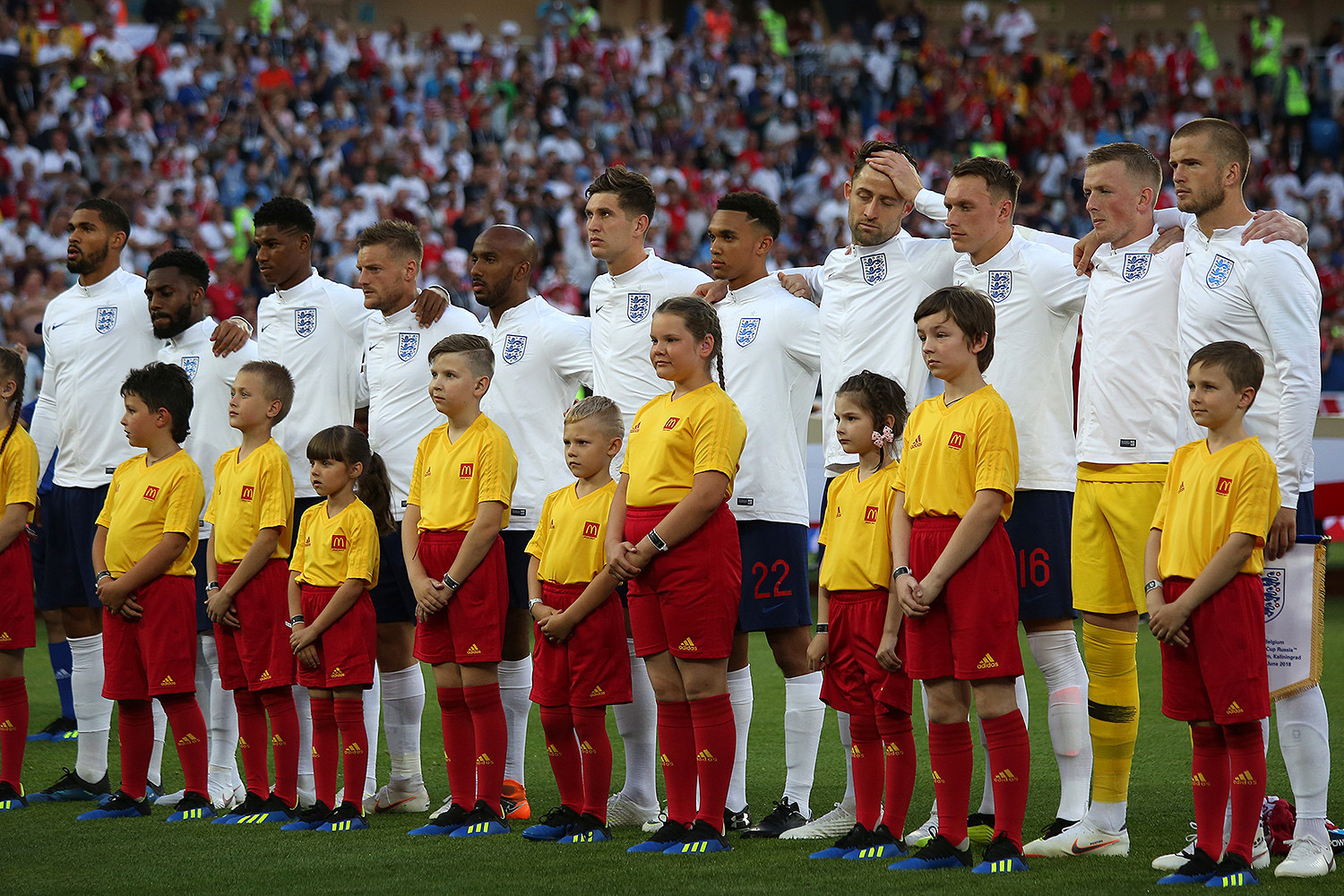
Photo: Кирилл Венедиктов / soccer.ru — CC BY-SA 3.0. England's starting eleven lining up at the 2018 World Cup.
That manager is Thomas Tuchel, the German coach appointed to lead England — a striking choice for a nation that has historically prized home-grown bosses. Tuchel arrives with a serial winner's CV, including a Champions League title, and a reputation for tactical ruthlessness in exactly the high-pressure knockout matches where England have so often fallen short. The thinking is simple: England have repeatedly had the players, but not always the nerve or the in-game management. Tuchel was hired to fix the second part.
Tuchel named his 26-man squad on 22 May 2026, and it delivered one of the biggest selection shocks in recent England memory (more on that below). The headline names are a forward's envy:
- Harry Kane — the captain and England's all-time leading goalscorer, one of the most complete strikers on earth. In 2026 he captains his third World Cup, equalling Billy Wright's England record, and the 2022 quarter-final penalty miss still stings — few would bet against him writing a different ending.
- Jude Bellingham — a generational midfielder who became a global superstar at Real Madrid, capable of dictating a match and scoring decisive goals from midfield. England's talisman for the next decade.
- Bukayo Saka — the electric, fearless winger who can win a knockout tie in a single moment of brilliance.
- Declan Rice — the midfield engine and leader who gives the side its steel and balance.
- The new-look attack — with several established names out of form at club level, Tuchel handed places to in-form players including Eberechi Eze, Anthony Gordon, Ollie Watkins, Ivan Toney and Kobbie Mainoo, reshaping England's forward line for the tournament.

The biggest talking point, though, was who didn't make it. Phil Foden and Cole Palmer — two of the Premier League's brightest talents — were both left out after disappointing club seasons, a ruthless call that split opinion and underlined Tuchel's willingness to pick on current form over reputation. Even so, with genuine strength in depth across every position, England travel to North America as one of the favourites — not the desperate hopefuls of decades past, but a side with the talent to win it and, finally, a manager hired to make sure they do. Whether that's enough to end sixty years of waiting is the question that will grip the country all summer.
Match Tickets and Fixtures: What Every Travelling Fan Should Know
Before we get to the travel, a word on the two things fans always ask about: tickets and fixtures.
Match tickets are sold exclusively through FIFA's official ticketing platform — not through travel agents, comparison sites or third-party resellers. JetMeAway does not sell match tickets, and neither should anyone claiming to be an unofficial seller: the secondary market for World Cup tickets is a notorious minefield of fakes, invalidated entries and rip-offs. Always buy through FIFA's official channels, register early for ticket releases and ballots, and be wary of any "guaranteed" tickets offered elsewhere. Treat anyone selling at a huge markup with deep suspicion.
England's group fixtures are confirmed. Following the 5 December 2025 draw, England play their Group L games in Dallas (17 June), Boston (23 June) and New York/New Jersey (27 June) — so you can book directly around those three East Coast cities rather than guessing. What's not yet known is England's knockout path, which depends on where they finish in the group. So the Scout's advice splits in two: book the group-stage trip now (flights and hotels for Dallas, Boston and New York, early and ideally refundable, because prices only climb as match dates approach), and keep the later legs flexible until England's route through the bracket is clear.
The golden rule: secure the expensive, in-demand things early and refundable; leave the cheap, flexible things until the picture is clear. Flights and your main hotel are the early commitments. Internal hops, car hire, eSIMs and activities can all wait. Get that sequence right and you'll travel for a fraction of what last-minute fans pay.
How to Follow England at the 2026 World Cup — Booking the Whole Trip
Here's the honest truth about following your country at a World Cup: the football is the easy part. The hard part — and the expensive part — is the logistics. Flights that triple in price around match dates. Hotels that sell out months in advance. Internal travel across a continent. Staying connected. Insurance. It's a lot, and it's exactly the kind of multi-part trip where booking smart saves you hundreds.

JetMeAway is built for precisely this. We're a UK-registered comparison engine (no markups, no booking fees — we earn a small commission from providers, which never changes your price) that brings live prices from 15+ trusted partners into one place. Here's how to assemble a World Cup trip, piece by piece.
Step 1: Lock in your flights early
Flights are the single biggest cost and the one most affected by tournament demand. Transatlantic fares climb steeply around World Cup dates, and the closer to a match you book, the more you pay. The Scout's rules:
- Book as early as you can. Prices only trend upward as a tournament approaches and seats fill.
- Be flexible on airport. Flying into a secondary hub (Newark instead of JFK, or a major connecting hub like Atlanta or Dallas) can be dramatically cheaper.
- Fly midweek. Weekend departures around match days are the most expensive; a Tuesday or Wednesday flight can save a meaningful chunk.
- Consider an "open-jaw" routing — flying into one host city and home from another — if you're following England through multiple rounds.
Compare live flight prices across providers on JetMeAway →
Step 2: Secure your accommodation before it sells out
Host-city hotels fill up fast and prices surge as matches approach. The trick is to book a refundable room early — you lock in today's price and protect your dates, with the option to cancel if your plans change once fixtures are confirmed. JetMeAway compares hotels across multiple providers, including direct-booking partners that let you complete the whole booking in one place. Base yourself near the stadium, or near reliable public transit, and you'll save both money and stress.
Compare hotels in the host cities →
Step 3: Sort getting around
North America is enormous, and the host cities are spread across it. Depending on your itinerary you may need:
- Internal flights between distant host cities (compare these the same way as your transatlantic flights).
- Car hire — close to essential in sprawling, car-dependent cities like Los Angeles, Dallas and Houston, and handy for reaching out-of-town stadiums. Compare car hire →.
- A plan for match-day transit, since many US stadiums sit outside city centres.

Step 4: Stay connected with a travel eSIM
Roaming charges in the US, Canada and Mexico can be brutal, and you'll be relying on your phone constantly — maps, ride apps, tickets, group chats, sharing the goals with everyone back home. A travel eSIM gives you affordable data the moment you land, with no physical SIM swap. JetMeAway compares eSIM plans for all three host nations. Get a travel eSIM →.

Step 5: Protect the trip with travel insurance
A World Cup trip is a significant investment, and US healthcare in particular is famously expensive without cover. Travel insurance protects you against cancellations, medical costs, lost baggage and the disruptions that long, multi-city trips can throw at you. Compare travel insurance →. It's also worth reading the FCDO's USA travel advice for entry requirements and the latest guidance before you travel.
Step 6: Build the holiday around the football
You've crossed an ocean — make the most of it. Between matches, these are bucket-list destinations: the museums and skyline of New York, the beaches of Miami and LA, the food scene of Mexico City, the national parks within reach of the western cities. Browse things to do and tours →, or consider a holiday package → that bundles flights and hotels together for added value and financial protection.
Smart Tips for Booking a World Cup Trip on a Budget
Following England needn't bankrupt you. The fans who do it affordably all follow the same playbook:

- Book the big-ticket items first and early. Flights and accommodation are where tournament pricing bites hardest. Everything else — transfers, eSIMs, activities — can wait, but flights and hotels reward the early and the decisive.
- Base yourself in a cluster. Rather than chasing England all over the continent, pick a region with several host cities within driving or short-flight distance and make it your hub. The central US cluster (Dallas, Houston, Kansas City, Atlanta) is far cheaper than the coasts.
- Group stages over knockouts. Group-stage tickets, flights and hotels are cheaper and easier than the latter rounds. If budget is tight, plan around the group phase and treat any knockout run as a bonus.
- Compare, don't assume. The first price you see is almost never the best. Running flights and hotels through a comparison engine across multiple providers routinely reveals double-digit-percentage savings — that's the entire reason JetMeAway exists.
- Watch the midweek and shoulder dates. Travelling a day either side of the obvious match-day rush, where your schedule allows, consistently undercuts peak pricing.
- Refundable first. With the group games set but England's knockout path still open, favour refundable flights and hotels so you can follow them deeper into the tournament without losing money if plans change.
A Sample England World Cup Trip: How It Could Look
To make this concrete, here's how a realistic, well-planned trip around England's confirmed Group L schedule might come together. The group games are fixed — Dallas, then Boston, then New York/New Jersey — so only the knockout legs depend on how far England progress.
The scenario: You want to follow all three England group games — Croatia in Dallas (17 June), Ghana in Boston (23 June) and Panama in New York/New Jersey (27 June) — with the option of staying on if they reach the knockouts.
- Opening match: You fly into Dallas for the opener, comparing fares and booking early before prices climb, with a couple of nights near the city or the Arlington stadium. Compare flights → · Dallas hotels →
- East Coast base: After Dallas you relocate east and make New York/New Jersey your hub for the last two games — Boston is a short, cheap hop or Amtrak ride away, and the New York fixture is on your doorstep. Flying midweek into Newark (EWR) rather than JFK saves money. Compare flights →
- Accommodation: You secure a refundable hotel in Jersey City — across the river from Manhattan, cheaper, and on a direct transit line to both the city and the stadium. Booked early, cancellable if your knockout plans firm up. Compare hotels →
- Boston game: For the Ghana match you take a quick internal flight or train up to Boston and one or two nights near the stadium in Foxborough. Compare flights →
- Getting around: In the cities you rely on public transit, but you compare car hire for the flexibility to reach the out-of-town stadiums on match day. Compare car hire →
- Staying connected: Before you fly, you set up a travel eSIM covering the USA, so your phone works the moment you land — maps, ride apps, tickets, sharing the goals. Get an eSIM →
- Cover: You add travel insurance to protect the whole trip against cancellation and the eye-watering cost of US medical care. Compare insurance →
- Between matches: You build in the bucket-list stuff — a Yankees game, the view from the top of the Rockefeller Center, a day at the beach. Browse things to do →
- If England go deep: Because you based yourself in New York and booked refundable where you could, you're perfectly placed to extend and chase a knockout run — adding nights and a final-weekend plan as the team progresses.
The whole trip — built piece by piece, compared across providers, booked early and refundable — is exactly the kind of complex, multi-leg journey that's painful to assemble one website at a time, and simple when you can compare everything in one place.
The Travelling Support: Following England Across a Continent
Wherever England go, the support goes too. The travelling England fan — flag draped over the shoulders, replica shirt on, voice already hoarse — is one of football's great sights, and in 2026 that support will fan out across an entire continent.

Following your country abroad is unlike watching at home. There's the camaraderie of finding other England fans in a bar in Boston or a plaza in Mexico City; the slightly surreal joy of singing "Three Lions" thousands of miles from Wembley; the friendships struck up with rival supporters from Brazil, Argentina or the USA. It's a pilgrimage as much as a holiday — and the stories you bring home often have as much to do with the cities, the people and the journey as with the football itself.

A few hard-won tips from fans who've done it before: pack light but bring the flag; learn the basics of the local transit before match day; keep both digital and paper copies of your tickets and travel documents; stay hydrated in the fierce American summer heat; and be a good ambassador — you're representing England, and the welcome you'll get next time often depends on the impression you leave this time.
Why Book Your World Cup Trip With JetMeAway

When you're spending real money to chase a once-in-a-lifetime trip across three countries, you want a booking partner that's genuinely on your side. Here's what JetMeAway brings:
- One search, every provider. We compare live prices from 15+ trusted flight, hotel, car and package partners in a single place, so you see the real market — not one company's pitch.
- No markups, no booking fees. We never add a penny to the price. We earn a small commission from our partners when you book, and it never changes what you pay.
- A real, UK-registered company. JetMeAway is JETMEAWAY LTD, registered in England & Wales — not an anonymous overseas reseller. You're booking with a company you can actually verify and contact.
- Built for complex trips. Multi-city, multi-leg, flights-plus-hotel-plus-car journeys are exactly what our comparison tools are designed to untangle — which is precisely what a continent-spanning World Cup demands.
England may not have lifted the trophy since 1966, but the dream of being there when they finally do is one of the great reasons to travel. Sixty years of waiting, a new generation, and a tournament unfolding across the most exciting corner of the football world. If this is the year — and every England fan, against all the evidence, believes it could be — you'll want to be in the stadium when it happens.
Start planning today, and let the Scout help you turn "it's coming home" into a trip that actually gets you there.
Frequently Asked Questions
Has England ever won the World Cup?
Yes — once. England won the FIFA World Cup in 1966, beating West Germany 4-2 after extra time at the old Wembley Stadium in London. Geoff Hurst scored a hat-trick — the first ever in a men's World Cup final, matched only once since (by France's Kylian Mbappé in the 2022 final, which France lost) and still the only one by a player on the winning side. Bobby Moore lifted the trophy as captain, and Alf Ramsey was the manager. It remains England's only major senior men's trophy. They've reached two World Cup semi-finals since (1990 and 2018) and lost the Euro 2020 and Euro 2024 finals, but have not won the World Cup again.
Did England really invent football?
England codified modern football. Ball games existed across many cultures for centuries, but the rules the whole world now uses — the Laws of the Game — date from the founding of The Football Association in London on 26 October 1863. The first official international match was also an England fixture: England versus Scotland in Glasgow in 1872. So while England didn't invent kicking a ball, it wrote the rulebook every World Cup match is played by.
Where is the 2026 World Cup being held?
Across three countries for the first time: the United States, Canada and Mexico, over 16 host cities. The USA stages most matches (11 cities) including the final; Canada hosts in Toronto and Vancouver; Mexico hosts in Mexico City, Guadalajara and Monterrey. It's also the first 48-team World Cup, with 104 matches, running from 11 June to 19 July 2026.
When and where is the 2026 World Cup final?
Sunday 19 July 2026 at MetLife Stadium — officially New York New Jersey Stadium for the tournament — in East Rutherford, New Jersey, the New York/New Jersey host region just outside Manhattan. The tournament opens on 11 June 2026 at the Estadio Azteca in Mexico City. If you're planning around seeing England in the final, New York is the city to book flights and hotels for earliest.
Which host cities are easiest for UK fans to reach?
New York/New Jersey, Los Angeles, Miami and Boston have the most direct flights from the UK. Atlanta, Dallas and Houston are big hub airports that often offer better value. In Canada, Toronto is an easy direct hop. In Mexico, Mexico City hosts the opening match but has fewer direct UK flights, so many fans connect via the US.
How do I book flights and hotels to follow England?
Use JetMeAway to compare live prices across 15+ providers in one place, with no booking fees. Start with flights to a host-city airport (e.g. New York JFK, Los Angeles LAX, Miami MIA), add a centrally located refundable hotel, then layer on car hire, a travel eSIM and travel insurance. Booking the flights and hotels early — well before match dates — is the biggest single way to keep costs down.
Do UK travellers need a visa for the USA, Canada or Mexico?
For tourism, UK passport holders typically need an approved ESTA for the USA, an eTA for Canada, and usually no visa for short tourist stays in Mexico (an immigration form applies). These electronic authorisations must be approved before you fly. Rules can change, so always check the official US, Canadian and Mexican government sites and UK FCDO guidance before booking, and ensure your passport has sufficient validity.
How much should I budget to follow England at the World Cup?
The biggest costs are flights and hotels, not match tickets. Transatlantic fares spike around tournament dates, and host-city hotels surge and sell out, so booking both early protects you. Factor in internal travel across a vast continent, plus a travel eSIM and insurance. Using JetMeAway to track and compare flight and hotel prices across providers is the simplest way to keep a World Cup trip affordable.
Who is the current England manager and captain?
England are managed by Thomas Tuchel, the German coach appointed to lead the team into the 2026 World Cup — a notable break from England's tradition of home-grown managers, chosen for his trophy-winning pedigree and knockout-football nous. The captain and talisman is Harry Kane, England's all-time record goalscorer, now captaining a record-equalling third World Cup, supported by a squad including Jude Bellingham, Bukayo Saka and Declan Rice. In a major surprise, Tuchel's 26-man squad (named 22 May 2026) left out Phil Foden and Cole Palmer after disappointing club seasons, with in-form names like Eberechi Eze, Anthony Gordon and Ivan Toney coming in.
Is the British Royal Family interested in football?
Very much so. Prince William, the Prince of Wales, has been President of the Football Association since 2006 and is a passionate Aston Villa fan who attends England games and FA Cup finals and gives the squad pep talks; his son Prince George now joins him. Queen Elizabeth II famously presented the trophy to Bobby Moore after the 1966 final. Other royals favour different clubs — Prince Harry leans to Arsenal, King Charles III to Burnley — but William's FA role keeps the Crown firmly tied to the Three Lions.
How many teams are in the 2026 World Cup?
For the first time, 48 teams — expanded from 32 — playing a record 104 matches across 16 host cities in the USA, Canada and Mexico, from 11 June to 19 July 2026. The bigger format means more games and a longer tournament window, so travelling fans following England deep into the competition should plan for a potentially extended trip.
Why hasn't England won the World Cup since 1966?
England wrote the rules of modern football and won at home in 1966, but the rest of the world embraced the game rapidly — Brazil, Germany, Italy and Argentina have all won more. England have come painfully close since (semi-finals in 1990 and 2018, plus the Euro 2020 and Euro 2024 finals), usually undone by the fine margins of knockout football and penalty shootouts. It's rarely been about a lack of talent — which is exactly why the FA hired knockout specialist Thomas Tuchel to try to finally get them over the line.
Is it cheaper to follow England in the group stage or knockouts?
The group stage is far cheaper and easier — flights, hotels and tickets all cost less and are simpler to secure than the latter rounds, where prices climb steeply towards the final. If money is tight, plan firmly around the group phase, book your transatlantic flights and base hotel early and refundable, and extend only if England progress. Comparing every leg on JetMeAway keeps the whole trip as affordable as possible.
Ready to start? Compare flights, find your hotel, sort car hire, grab a travel eSIM and protect your trip — all in one place, with no booking fees. The Three Lions are waiting. So is North America.
— And if you have Scottish friends or family making the same trip, here is the Scout's full guide to Scotland at the 2026 World Cup →.
Did England invent football?
How can I book a trip to follow England at the 2026 World Cup?
Which 2026 World Cup host cities are best for UK fans?
How much does it cost to follow England at a World Cup?
When is the 2026 World Cup final and where is it?
Is the British Royal Family involved in football?
Why hasn't England won the World Cup since 1966 if they invented football?
Is it cheaper to follow England in the group stage or the knockout rounds?
What are England's confirmed Group L fixtures and venues?
What is MetLife Stadium called during the World Cup, and how do I get there?
What is Kansas City's World Cup stadium and is it worth basing there?
How do I get from Dallas to Boston or New York between England's group games?
Do I need an ESTA for the USA even if I'm only transiting through an American airport?
Do I need separate visas or eTAs for each World Cup host country?
Are there direct flights from the UK to England's three Group L cities?
Which airlines fly direct from the UK to New York for the final?
Can I buy World Cup tickets on resale sites or from touts?
What is a safe fan zone and will there be one in England's host cities?
What should I pack and prepare specifically as an England fan travelling to the USA?
If England reach the knockout rounds, how do I know which city the next match is in?
Is Mexico City a realistic option for England fans, and what's different about travelling there?
Should I book refundable flights and hotels for England's group games, or wait?
Read next


Plan Your 2026 Trip Now
Use the JetMeAway Scout to compare live prices across 15+ trusted providers. Zero booking fees.
Start Searching