
The Smart Traveller's Scout Secret: Why Comparison Apps Rule Holiday Planning in 2026
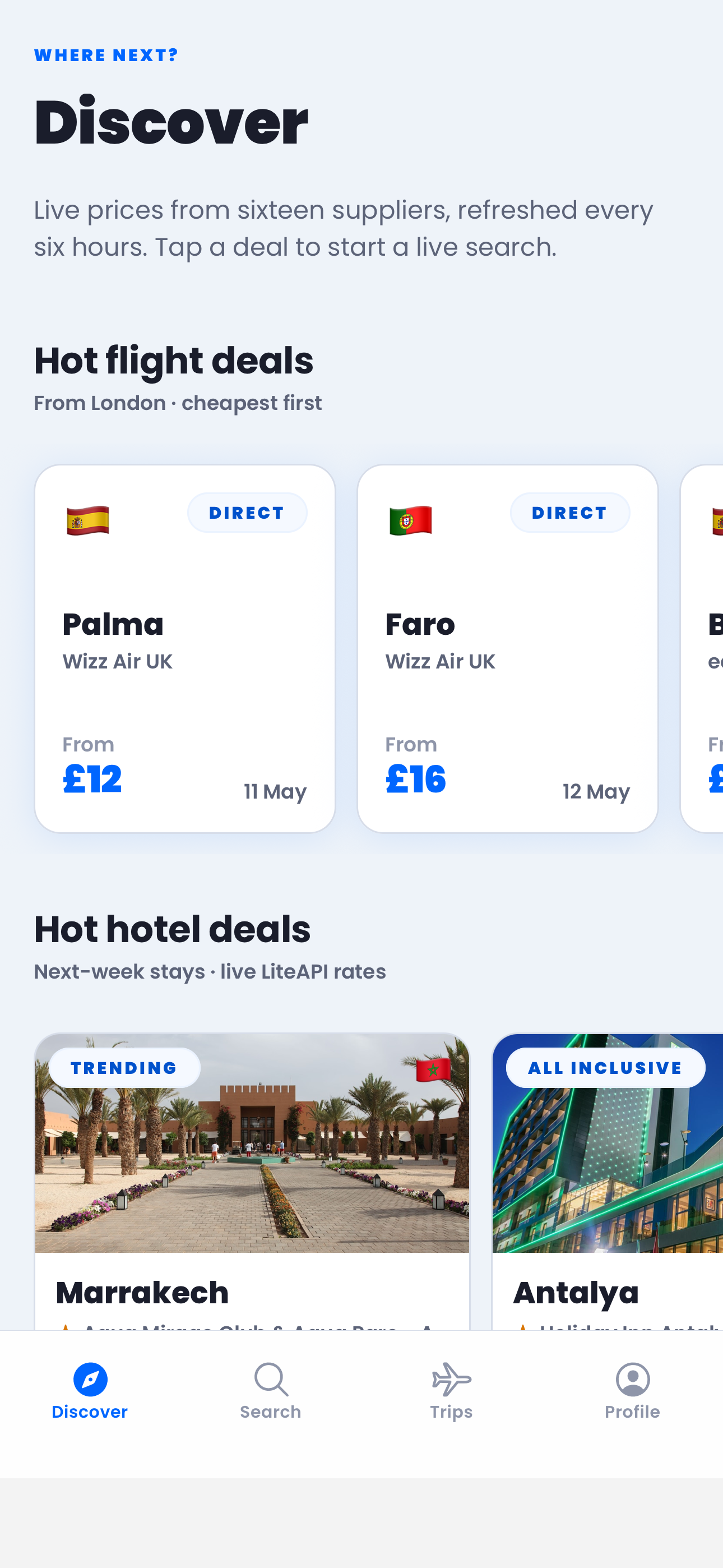
Twenty open browser tabs and a slowly building headache used to be the price of planning a good holiday. In 2026 the best travel comparison apps put the same firepower in your pocket — only faster, cheaper, and crucially, less likely to be sabotaged by hidden surcharges and "limited-time" pop-ups. The shift isn't subtle. UK travellers booking on mobile spent 47% more time researching and 31% less time price-checking on the day of booking than desktop users (Expedia Group, 2025), and emerged with bookings that were on average 6–9% cheaper. Most of that saving has nothing to do with the apps being magical — it's that the constraint of a smaller screen forces you to compare, anchor, and decide rather than endlessly browse.
This guide ranks every category of comparison tool UK travellers actually use in 2026 — meta-search engines, hotel comparison apps, all-inclusive package operators, and specialist tools for the trips that don't fit a standard search box — on three things that actually matter: transparency (do you know who you're really booking with and what it costs), value (does comparing actually save you money), and UX (can you get from "I want to go somewhere" to "booked" without fighting the interface). No single app wins every category, which is exactly why the smart move is a small, deliberate stack rather than one app trying to do everything.
Jump to a section: Meta-search engines · Hotel comparison apps · All-inclusive package operators · Specialist tools · The 2026 app stack · FAQ
Scout's quick take: if you only remember one thing from this guide — compare on a purpose-built engine before you commit to any single supplier's site, and don't stop at the first "cheapest" badge you see. The few minutes it takes routinely pays for a night's hotel or more on a family trip.
The Scout's Take: Why Comparison Tools Matter More in 2026
Ten years ago, "comparing prices" meant opening Skyscanner, Expedia, the airline's own site and maybe a hotel chain's app, cross-referencing them in your head or on a spreadsheet, and hoping you remembered which tab had which number. The category has matured since then. Meta-search engines now poll live inventory from dozens of suppliers in the time it takes to load a page; hotel comparison tools normalise room types and cancellation policies so you're comparing like-for-like rather than a flexible rate against a non-refundable one; and package operators have gotten much more transparent about what a headline price does and doesn't include.
What hasn't changed is the underlying economics. Every comparison tool in this guide is free to use and earns a small affiliate commission when you book through it — the same commission the supplier would pay regardless of which comparison tool sent the booking. That business model matters because it means an honest comparison tool has no reason to hide the genuinely cheapest option from you; it gets paid either way. The tools worth using are the ones that lean into that incentive rather than working against it — showing you the real spread across suppliers, flagging when a "deal" is actually a stripped-down non-refundable rate, and getting out of the way once you've decided.
The other 2026-specific shift is where the comparison itself happens. JetMeAway runs entirely on Vercel's global edge network, so a search from Manchester and a search from Lisbon both return live results in milliseconds rather than round-tripping to a single central server. That's not a marketing detail — it's the difference between a comparison tool you actually use mid-scroll on your phone and one you give up on because it feels slow. Speed compounds with trust: an app that's fast enough to check "just to be sure" gets checked more often, and checking more often is exactly what saves money.

Meta-Search Engines — Skyscanner, Kayak, Google Flights, JetMeAway
Meta-search is the category most UK travellers reach for first, and for good reason — these tools don't sell you a seat directly, they scan across airlines and travel agents and show you the live spread, then hand you off to book with whoever's actually cheapest for your dates. The category has three strong, genuinely different players plus one newer entrant built specifically for UK travellers who want the whole trip, not just the flight, compared in one place.
JetMeAway — the whole trip, one screen, no padding
JetMeAway compares flights across 250+ airports and hotels across 160+ cities, side-by-side with packages, car hire, eSIM data and travel insurance — all on one screen, with no affiliate-padded ranking trick. The cheapest result is the cheapest result, and we tell you which supplier you'd be transacting with for every line. The homepage auto-detects your nearest UK airport from 18 covered (Heathrow, Gatwick, Manchester, Edinburgh, Birmingham, Bristol and the rest) and pre-fills your search before you've typed a thing.
For flights specifically, JetMeAway runs a live Travelpayouts search that polls real airline inventory, with a cached Aviasales fallback so you're never staring at a blank results page while the live poll completes. Three flight providers compete on every route — Aviasales, Trip.com and Expedia — and hotels compare across seven: Expedia, Trip.com, Hotels.com, Agoda, Trivago, RateHawk and Webbeds, plus direct LiteAPI rates. That's a deliberately narrower hotel list than some rivals — the biggest OTAs are left out, a choice explained fully in the hotel comparison section below — but every provider that is included is one we have a direct, transparent commercial relationship with.
Transparency: high — every result shows the actual supplier, no dark-pattern urgency timers. Value: strong on both flights and hotels because it's comparing across genuinely competing suppliers rather than one inventory source. UX: built mobile-first with the fewest taps from search to comparison of any tool in this guide, and the fastest page loads thanks to edge deployment.
Skyscanner — still the best "I don't know where I want to go" tool
Skyscanner's standout feature since its earliest days remains its best one in 2026: "Everywhere" search, which shows the cheapest destination from your home airport across an entire month when you have no fixed destination in mind. Pair it with the month-view price calendar and you can spot the cheapest week to travel without manually re-searching date by date.
Where Skyscanner falls short is depth beyond flights — its hotel and car hire coverage exists but is thinner than dedicated tools, and some flight results route through third-party booking agents whose customer service, if something goes wrong with your booking, is a genuine step down from booking direct or through a comparison engine that surfaces the supplier plainly. Use Skyscanner to find the destination and the rough price band, then verify the actual fare and who you're really booking with on a second tool before paying.
Transparency: medium — some agent-routed results obscure who you're really transacting with. Value: strong specifically for flexible-destination search. UX: clean and fast, one of the most polished flight search interfaces on the market.
Google Flights — the fastest way to find the cheapest day on a fixed route
If you already know where you're going and just need to know when to fly, Google Flights' price graph is the fastest tool for the job — a bar chart across your date range that instantly reveals which days are cheap and which are expensive, no manual re-searching required. The "track prices" feature emails you when a fare on a saved route drops, which is genuinely useful for a trip you're not booking immediately but want to catch at the right moment.
Google Flights doesn't do hotels, packages, car hire, eSIM or insurance, so it's a single-purpose tool by design — most UK travellers pair it with a fuller comparison engine for the rest of the trip once the flight dates are locked. It also doesn't always surface every low-cost carrier's fares (some budget airlines opt out of appearing), so cross-check directly with easyJet, Ryanair or Wizz Air if your route is short-haul European.
Transparency: high — Google shows the operating airline clearly and rarely routes through opaque third-party agents. Value: best-in-class for date flexibility on a fixed route. UX: the price graph and calendar view are the fastest date-shopping tool in this guide.
Kayak — the price-forecast specialist
Kayak's Price Forecast tool predicts whether a fare on your route is likely to rise or fall over the coming days, which is a genuinely different value proposition to Skyscanner or Google Flights — it's aimed at travellers with flexible booking timing rather than flexible dates or destinations. Its Hotels tab also layers in filters (specific neighbourhood, minimum guest rating, amenities checklist) that go a little deeper than some rivals' hotel search.
It's worth a second look if your first search on another meta-search tool didn't turn up a fare you're happy with, but running three or four different meta-search tools for the same trip tends to show diminishing returns after the second — the results overlap more than they differ once you've checked two independent engines.
Transparency: medium-high — clearly labels forecast confidence and supplier. Value: genuinely useful forecast feature, though accuracy varies by route. UX: slightly denser interface than Google Flights or JetMeAway, more filters to wade through.
Meta-search comparison table
| Tool | Best for | Covers beyond flights | UK-specific features |
|---|---|---|---|
| JetMeAway | Whole-trip comparison in one place | Hotels, packages, cars, eSIM, insurance | 18-airport UK geolocation, edge-speed search |
| Skyscanner | Flexible destination ("Everywhere" search) | Thin hotel/car coverage | Strong UK short-haul coverage |
| Google Flights | Fixed route, flexible date | None — flights only | Price graph, price tracking |
| Kayak | Price-rise/fall forecasting | Hotels with deep filters | Price Forecast tool |
Search live UK flights across three providers before you commit to a date, then carry straight on to UK hotel comparison once your dates are locked.
Hotel Comparison Apps — JetMeAway, Trivago, Kayak Hotels
Hotel comparison is a different problem to flight comparison. Flights are largely commoditised — the same seat on the same plane is the same product no matter who sells it to you — but hotel rates genuinely vary by provider because of different contracted allocations, loyalty pricing, and cancellation terms bundled into the headline price. A "cheapest" badge on a hotel search is only meaningful if it's comparing the same room type and the same cancellation policy across providers, not a stripped-down non-refundable rate against a fully flexible one.
JetMeAway hotels — seven providers, direct rates, full transparency
JetMeAway compares hotels across 160+ cities through LiteAPI, RateHawk and Webbeds direct contracts, with a Hotellook fallback for broader coverage, spanning seven consumer-facing providers: Expedia, Trip.com, Hotels.com, Agoda, Trivago, RateHawk and Webbeds. Photo galleries pull from Unsplash and Google Places rather than a single hotel's own (often outdated) marketing photos, and the price grid flags the genuine cheapest option with a "Cheapest" badge once room type and cancellation terms are normalised across providers.
JetMeAway’s hotel grid is deliberately curated. This isn't an oversight — every provider in JetMeAway's grid is one we hold a direct, transparent affiliate or supply relationship with, and the seven-provider spread already gives a meaningful cross-section of the market: Agoda's strength on Asian destinations, RateHawk and Webbeds' direct-contract rates on European city hotels, Hotels.com's stamp-card loyalty scheme (book 10 nights, get 1 free), Expedia and Trip.com's broad global coverage, and Trivago's own meta-search layer on top. A narrower, fully transparent comparison beats a wider one padded with a listing that doesn't reflect an actual commercial relationship.
Transparency: high — direct LiteAPI/RateHawk/Webbeds contracts plus clearly labelled OTA comparison. Value: strong; the seven-provider spread genuinely surfaces different winners by destination. UX: photo galleries with scroll-snap and dot indicators, price grid designed for quick scanning on mobile.
Trivago — hotel-only meta-search, broad global database
Trivago is a hotel-only meta-search tool, conceptually similar to the hotel side of JetMeAway's comparison grid — it scans multiple booking sites for the same property and surfaces the lowest listed price it finds. It doesn't cover flights, car hire, packages, eSIM or insurance, so travellers using it as their primary tool end up needing two or three additional apps to plan the rest of a trip.
Where Trivago earns its keep is database breadth — a very large global hotel inventory that's useful as a cross-check even when you're using a fuller comparison engine as your main tool, particularly for smaller independent properties that don't always appear on every platform.
Transparency: medium — meta-search model means the actual booking happens on a third-party site, so read the final rate conditions there. Value: solid for a second-opinion check. UX: ad-heavy on the free web version, cleaner on the dedicated app.
Kayak Hotels — deep filters for narrowing a big city
Kayak's hotel search layers in filters most other tools keep simpler — specific neighbourhood boundaries, minimum guest rating thresholds, amenity checklists (pool, parking, pet-friendly) — which is genuinely useful when you're searching a large city and know roughly what you want but not which specific hotel. It shares the same Price Forecast concept from Kayak's flight tool, applied to hotel rates, flagging whether a rate on your dates looks likely to move.
Transparency: medium-high. Value: the filter depth is the standout feature — worth using specifically when you're narrowing a big city search rather than comparing a shortlist you've already built. UX: denser than JetMeAway or Trivago, more powerful once you learn the filter panel.
Hotel comparison table
| Tool | Providers compared | Standout feature |
|---|---|---|
| JetMeAway | Expedia, Trip.com, Hotels.com, Agoda, Trivago, RateHawk, Webbeds (+ LiteAPI direct) | Whole-trip comparison alongside flights, cars, packages |
| Trivago | Broad multi-OTA meta-search | Very large global hotel database |
| Kayak Hotels | Multi-OTA with deep filters | Neighbourhood/amenity filter depth |
Whichever tool you use first, always click through to confirm the room type and cancellation policy before trusting a "cheapest" badge — the badge is only as good as the normalisation behind it. Compare live hotel prices across seven providers once you've picked a shortlist of cities or neighbourhoods.
All-Inclusive & Package Operators — TUI, Jet2holidays, easyJet Holidays
Package holidays are a genuinely different comparison problem to flights or hotels alone, because the thing you're comparing isn't a single line item — it's a bundle of flight, hotel, transfers and sometimes board basis, priced as one number, and protected under a different financial scheme (ATOL) than a DIY flight-plus-hotel combination.
TUI — the largest UK package operator, own-brand hotel control
TUI runs the UK's biggest package holiday operation, combining its own charter flight network with a large portfolio of contracted and own-brand hotels (TUI BLUE, TUI Sensatori, TUI Suneo) across the Mediterranean, Caribbean, and long-haul beach destinations. Its scale is the main advantage: bulk-bought hotel allocations and charter capacity let TUI undercut a DIY-assembled trip for larger families, particularly in peak school-holiday weeks when scheduled-airline fares spike hardest.
Every TUI package that includes a flight is ATOL-protected, meaning your money is covered if TUI became unable to trade before or during your trip. The trade-off against booking separately is less control — you're choosing from TUI's own hotel list rather than the full open market, and departure airports and times are constrained to TUI's charter schedule.
Jet2holidays — strong regional UK departure coverage
Jet2holidays pairs Jet2's scheduled flight network with contracted hotel deals, and its particular strength is regional UK departure airports — Leeds Bradford, Newcastle, East Midlands, Belfast — where TUI's network is comparatively thinner. Like TUI, it's ATOL-protected as a package, and it has built a reputation for transparent baggage and transfer inclusion in the headline price rather than surprise add-ons at checkout.
For families based outside the South East, Jet2holidays is frequently worth pricing first specifically because of that regional airport strength — a package leaving from your actual nearest airport, rather than one requiring a domestic connection or a long drive south, often wins on total trip cost even before comparing headline prices.
easyJet holidays — scheduled-network flexibility inside a protected package
easyJet holidays is a genuine ATOL-protected package operator, not simply a bundled booking flow layered on top of flight sales — it negotiates its own hotel rates and offers the same financial protection as TUI or Jet2holidays when flight and accommodation are booked together. Because it's built on easyJet's scheduled network rather than dedicated charter flights, it offers a wider spread of departure times and, in many cases, more flexibility to mix a specific flight time with a specific hotel than a traditional charter-based package operator.
DIY versus package — when each one wins
The honest answer is that neither approach automatically wins — it depends on party size, destination, and how much you value control over the specific hotel. As a rough guide from comparing real trip costs:
| Trip type | Package operator tends to win | DIY (flights + hotel separately) tends to win |
|---|---|---|
| Family of 4+, peak school holidays, beach resort | Yes — bulk-bought allocations undercut scheduled fares | Rarely |
| Couple, city break, flexible dates | Rarely | Yes — more hotel choice, cheaper off-peak fares |
| Specific boutique hotel not on any package list | No | Yes — the only route to that property |
| Last-minute beach holiday (under 4 weeks out) | Often — unsold package inventory gets discounted hard | Rarely — scheduled fares rise as departure nears |
| Multi-city or multi-country trip | Rarely — packages are built around one resort | Yes — DIY is the only practical route |
Always price both routes for your actual dates before assuming one wins by default — the gap can run either way by a meaningful margin, and it changes trip to trip. If you go the DIY route, compare flights and compare hotels separately through JetMeAway to see the real spread on both halves; for the packaged route, get quotes from at least two of the three operators above for the same dates and board basis before booking.
Specialist Tools — Hopper, Rome2Rio and the Trips That Don't Fit a Standard Search
Not every trip fits neatly into "search flights, search hotels, book." Flexible-date travellers, multi-leg journeys through regional airports, and anyone trying to work out whether a cheap flight into a small airport is actually a false economy once transfers are added all need a slightly different tool.
Hopper — price prediction for flexible travellers
Hopper is a mobile-only app built around historical fare data, predicting whether a flight or hotel price on your route is likely to rise or fall over the coming days and pushing a notification telling you to "book now" or "wait". It's most valuable for travellers who are genuinely flexible on exact booking date and happy to sit on a predicted dip rather than needing to lock a fare immediately.
Hopper also sells Price Freeze, a paid option to lock in a fare for a short window without committing to the ticket. Treat this as optional insurance rather than a necessity — compare the freeze fee against the realistic chance the price actually rises by more than that fee before paying for it. For travellers with a fixed date and no real flexibility, Hopper's prediction feature has limited use; go straight to a meta-search comparison instead.
Transparency: medium — predictions are probabilistic, not guaranteed, and Hopper is upfront about this. Value: genuinely useful for flexible bookers; less useful for fixed-date trips. UX: mobile-only, notification-driven, a different interaction model to a traditional search-and-compare tool.
Rome2Rio — the door-to-door reality check
Rome2Rio maps every practical way to travel between two points — flights, trains, coaches, ferries, driving — which makes it the single best tool in this guide for spotting when a cheap short-haul flight isn't actually the cheapest or fastest way to get somewhere once the full journey is counted. A £35 Ryanair return into a small regional airport looks unbeatable until Rome2Rio shows the airport is 50km from the city you actually want to reach and the connecting bus runs once an hour.
Use Rome2Rio before you commit to a specific arrival airport on a comparison engine, not after — it's the tool that tells you whether "cheapest flight" and "cheapest trip" are actually the same search. For UK domestic and short European hops specifically, it's also a fast way to check whether a train beats flying door-to-door once airport transfer time on both ends is added in.
Transparency: high — shows all transport modes without favouring flights. Value: high specifically for regional-airport routes and multi-modal journeys. UX: map-based interface, less of a traditional price-comparison layout, more of a route-planning one.
Citymapper and Trainline/Omio — the last mile and the rail alternative
Citymapper picks up where Rome2Rio's high-level route mapping leaves off, handling the granular "how do I actually get from this airport to this hotel" question inside a city once you've arrived. For UK domestic and EU short-haul specifically, trains often beat flights door-to-door once airport time is factored in — Trainline and Omio both handle rail booking, and the savings on shorter European hops can run 30–40% versus a budget airline once luggage fees and both-end transfers are added to the flight's headline price.
Specialist tools comparison table
| Tool | Solves for | Best used | Not designed for |
|---|---|---|---|
| Hopper | Predicting price direction | Flexible-date bookers willing to wait | Fixed-date, need-it-now bookings |
| Rome2Rio | Whole-journey routing across all transport modes | Before picking an arrival airport | Actual booking — it's a route map, not a checkout |
| Citymapper | Last-mile transport inside a city | Once you've landed | Cross-country or international routing |
| Trainline / Omio | Rail booking and rail-vs-flight comparison | UK domestic and short-haul Europe | Long-haul or non-rail-served routes |
Search flights across 250+ UK airports once Rome2Rio has confirmed your chosen airport is actually the sensible arrival point, not just the cheapest headline fare.
Ranking the Field — Transparency, Value and UX Compared
Pulling every category together, here's how the tools in this guide stack up against the three criteria that matter most for a UK traveller deciding where to spend their planning time.
| Tool | Category | Transparency | Value | UX | Best single use case |
|---|---|---|---|---|---|
| JetMeAway | Whole-trip comparison | High | Strong across flights, hotels, cars, packages | Fastest, mobile-first, edge-speed | One app for the whole trip, no padding |
| Google Flights | Meta-search (flights only) | High | Best for fixed-route date-shopping | Fastest date comparison of any tool | Finding the cheapest day on a known route |
| Skyscanner | Meta-search (flights-led) | Medium | Strong for flexible destination | Clean, polished | "Everywhere" search when destination is open |
| Kayak | Meta-search + hotels | Medium-high | Useful forecast feature | Denser, more filters | Predicting whether a fare will rise or fall |
| Trivago | Hotel-only meta-search | Medium | Solid second opinion | Ad-heavy on web, cleaner on app | Cross-checking a hotel rate you've already shortlisted |
| TUI | Package operator | High (ATOL) | Strong for large families, peak season | Traditional package booking flow | Family beach holiday, peak school holidays |
| Jet2holidays | Package operator | High (ATOL) | Strong for regional UK departures | Traditional package booking flow | Booking from a regional airport outside the South East |
| easyJet holidays | Package operator | High (ATOL) | Strong flexibility within a protected package | Scheduled-network booking flow | Wanting package protection with scheduled-flight flexibility |
| Hopper | Price prediction | Medium (probabilistic) | High for flexible bookers | Notification-driven, mobile-only | Waiting out a predicted price dip |
| Rome2Rio | Route mapping | High | High for regional-airport routes | Map-based, not a checkout | Checking the real door-to-door cost before booking a flight |
No single row in that table is "the winner" for every trip — that's the point. The travellers who consistently get the best combination of price and experience aren't loyal to one app; they run a small, deliberate stack and know which tool answers which question.
The 2026 Pocket Stack — Four Apps, No Chaos
Rather than juggling every tool in this guide for every trip, most UK travellers settle into a small, repeatable stack. Here's the version we'd recommend, and why each slot earns its place.
1. Beat the algorithm with real-time price tracking
Prices move by the minute. European short-haul return fares can swing 18% within 48 hours, and hotels in capital cities routinely see 6–10% intra-day movement on weekends. The trick isn't refreshing manually — it's letting the engine watch for you, or checking a fast enough comparison tool that re-checking costs you nothing.
JetMeAway fills this slot: flights across 250+ airports and hotels across 160+ cities, side-by-side with packages, car hire, eSIM data and travel insurance, all on one screen. The whole engine runs on Vercel's global edge network, so search responses land in milliseconds whether you're in Manchester, Lisbon or Pondicherry. The homepage auto-detects your nearest UK airport from 18 covered and pre-fills your search before you've typed a thing.
The myth that prices change based on your cookies is largely that — a myth. Consumer Reports tested 372 searches and found identical prices 88% of the time. What does move prices is the window: 18–29 days before international flights and 7–15 days before hotel stays are the cheapest sweet spots in 2026.
2. Hyper-personalised comparison beats generic listings
The age of "here are 200 hotels, sort by price" is over. The shape of UK travel in 2026 is "I'm a couple, doing a slow week in Andalucía, want a boutique riad on day one and a beach hotel on day three, must have hand-luggage-only flights from Manchester." That's a real itinerary, not a search filter — and the apps that can hold it together are the ones winning attention.
JetMeAway lets you anchor on the destination first, then compare flights, hotels, car hire, packages, eSIM data and travel insurance all in one place. The Scout layer adds context most comparison sites strip out: which neighbourhood the hotel is actually in, which UK airport flies the route most reliably, whether the package or the DIY route works out cheaper for your specific dates.
For deeper itinerary planning once you've booked pieces of the trip across multiple sites, pair JetMeAway with TripIt or Wanderlog — forward your booking confirmations to TripIt at plans@tripit.com and it auto-assembles the full trip into a single offline-readable schedule.
3. All-in-one transport logic, not just flights
Comparing flights alone misses half the picture, as the specialist tools section above covers in depth. Rome2Rio and Citymapper show the actual A-to-B options — including overland legs — so you can see the full door-to-door cost and time before you commit to an arrival airport.
Use Rome2Rio for the transport scan, then come back to JetMeAway for the hotel once you know which arrival airport actually makes sense. For UK domestic and EU short-haul, trains often beat flights door-to-door once you factor in airport time — Trainline and Omio both handle that.
The pocket stack table
| Tool | What it does | When to use it |
|---|---|---|
| JetMeAway (iOS · Android · Web) | All-in-one comparison: flights, hotels, packages, cars, eSIM, insurance | First scan for any new trip — destination + dates |
| TripIt or Wanderlog | Auto-assembles bookings into one itinerary | After you've booked anything |
| Maps.me | Offline maps of the entire world | Before you leave home Wi-Fi |
| Airalo or Yesim (/esim) | eSIM data in 150+ countries from £3.50 | The day you land, no roaming bill |
That's the lot. Four apps, no chaos, no 20-tab browser session, and a holiday that arrives at the price you compared rather than the price the operator wanted.
Get JetMeAway on Your Phone
The JetMeAway app puts the whole comparison engine — flights across 250+ airports, hotels across 160+ cities, eSIM, car hire, packages, travel insurance — into a tab on your home screen. Free, no account required to search, and price-locked at the moment you book.
- 📱 iOS — App Store
- 🤖 Android — Google Play
- 💻 Web — jetmeaway.co.uk on any browser
The mobile app uses biometric unlock (Face ID / Touch ID) for the Trips tab so your saved itineraries stay private even if your phone walks off, and an offline-first Trips view means your booking confirmations open cleanly even at 38,000 feet on a flight without Wi-Fi.
A Quick Traveller-Style Quiz
If you're still unsure which app to lead with, three questions will tell you:
- What matters most when booking? Lowest price (A) — Unique stays (B) — Mapped-out itinerary (C)
- How do you prefer to get around? Whatever's fastest and cheapest (A) — Walking and exploring (B) — Mix of public transport (C)
- Your "deal-breaker" for a holiday? Overpaying for a flight (A) — A boring cookie-cutter hotel (B) — Getting lost or wasting time (C)
Mostly A's — The Budget Hawk. JetMeAway for the cheapest fare scan, then Hopper for predictive price-drop alerts on the route once you've shortlisted.
Mostly B's — The Experience Seeker. JetMeAway for the seven-provider stays comparison; pair with Tripadvisor for reviews on under-the-radar properties.
Mostly C's — The Master Planner. JetMeAway for the comparison anchor, Wanderlog for the visual itinerary, Citymapper or Rome2Rio for the on-the-day transport.
Common Mistakes UK Travellers Make When Comparing Apps
Stopping at the first "cheapest" badge. As covered in the hotel comparison section, a badge is only meaningful if room type and cancellation terms are normalised across providers. Always click through and check before trusting it fully.
Running five meta-search tools for one trip. Two independent engines — one flight-focused, one whole-trip — cover almost all the ground. Beyond that, the extra time spent rarely turns up a materially better price, as covered under the meta-search rankings.
Comparing flights and hotels in isolation from packages. If you're travelling as a family of four or more to a beach destination in peak season, always price a TUI, Jet2holidays or easyJet holidays package alongside your DIY flight-and-hotel comparison — see the DIY versus package table for when each route tends to win.
Ignoring the arrival airport's real distance from the destination. A cheap flight into a small regional airport can cost more overall once a slow transfer is added — the exact problem Rome2Rio exists to catch, covered above.
Assuming a package always includes full protection. ATOL covers operator insolvency when flight and hotel are booked together as a package, but comprehensive medical, cancellation and baggage cover typically needs a standalone travel insurance policy — check what's actually included before assuming you're covered, and compare cover types if you need it.
Booking the eSIM at the airport instead of before flying. Most eSIMs activate on arrival, not on purchase — buying through JetMeAway's eSIM comparison before you leave the UK means you land with working data immediately.
The Bottom Line
Apps haven't replaced travel agents — they've replaced the bad parts of travel agents. The hidden margin, the "have I told you about our partner hotel?" upsell, the ten-minute hold music. The good parts (someone who actually knows the route, knows the destination, knows when the airline price is about to drop) are now you, with the right apps in your pocket: a meta-search engine for the flight, a hotel comparison tool that shows the honest spread, a package operator comparison for family beach trips, and a specialist tool like Rome2Rio for the journeys that don't fit a standard search box.
Start with JetMeAway — iOS, Android or jetmeaway.co.uk on the web — for the comparison scan across flights, hotels, packages, cars, eSIM and insurance, layer in TripIt for the itinerary, Maps.me for offline navigation, and Rome2Rio when a route looks too good to be true. That's the 2026 toolkit.
For more on getting the flight side of the equation right before you even open a hotel comparison, see our full UK flight hacks guide for 2026, and if your trip includes a specific city, our destination guides — like Barcelona hotels, Paris hotels and Dubai hotels — go deep on where to actually stay once you've picked the destination.
FAQ
Every question UK travellers ask us about comparison apps — meta-search versus booking sites, why some tools show different prices than others, ATOL protection on packages, why we curate the hotel grid to direct-relationship providers, and how much comparing genuinely saves — is answered in the FAQ block above this section.
Ready to Compare Your Trip?
Every tool in this guide does one job well. JetMeAway is built to do the whole trip in one place — flights, hotels, packages, cars, eSIM and insurance — with no padding and no markup.
What's the single best travel comparison app for UK travellers?
Do hotel and flight prices change based on my browser cookies?
Are mobile-only discounts a real thing?
What apps should I download before any 2026 trip?
What's the difference between a meta-search engine and a booking site?
Is Skyscanner still worth using?
Is Google Flights better than Skyscanner?
Do meta-search apps ever show a different price than the airline or hotel's own site?
Why does JetMeAway show live prices for some routes and cached prices for others?
Is Kayak worth using alongside Skyscanner?
What is Hopper and how does its price prediction work?
What is Rome2Rio and when should I use it?
Are all-inclusive package holidays cheaper than booking everything separately?
What does ATOL protection mean and why does it matter when comparing package holidays?
Is TUI or Jet2holidays better value for UK families?
Is easyJet holidays a real package operator or just flight-plus-hotel bundling?
What is a hotel comparison app and how is it different from booking directly with a hotel chain?
Which hotel providers does JetMeAway’s comparison include?
Why does JetMeAway compare seven hotel providers instead of just showing 'the cheapest'?
What is Trivago and how does it differ from a full comparison engine?
How much can I realistically save by comparing prices across apps instead of booking on the first site I find?
Should I trust the 'X people are looking at this right now' and countdown timers some booking sites show?
Are price-comparison apps free to use, and how do they make money?
What should I check before trusting a comparison app's 'cheapest' badge?
Can I use a comparison app for a multi-city or round-the-world trip?
How do I compare car hire prices alongside flights and hotels?
Do I need travel insurance if my package holiday already includes some cover?
What's the best eSIM comparison approach for a UK traveller heading abroad?
Is it better to book flights and hotels together or separately?
Read next
 Trends
Gen Z Travel in 2026: How UK 18–26s Are Ditching Memes for Scout-Led Holidays
 Wellness
Beyond the Buffet: How to Find 'High-Vibe' Neighbourhoods for Your Next Work-From-Anywhere Week
 Wellness
Rishikesh Yoga Sabbatical 2026: A 14-Day Guide for UK Travellers
Plan Your 2026 Trip Now
Use the JetMeAway Scout to compare live prices across 15+ trusted providers. Zero booking fees.
Start Searching